Ali Shapouran
Having a long history since the 16th century, the Carberry Tower was passed into the Elphinstone family in 1801 and was redesigned by the 15th Lord Elphinstone, William after 1861 when he succeeded to the estate. His son, Sydney Herbert Elphinstone was born in the Carberry Tower in 1869. He succeeded William and lived in the Tower until he died in 1955. Her wife, Lady Elphinstone Mary Bowes-Lyon, the sister of Queen Elizabeth II, lived there after her husband until she died in 1961. The tower was bequeathed to the Church of Scotland by Lady Elphinstone. In this year, the collection was acquired by the University of Edinburgh.

Therefore, the manuscripts belonged to the Elphinstone family, who had been important players in the East India Company. Several manuscripts were evidently commissioned by, dedicated to, or transcribed for Mountstuart Elphinstone (1789-1859). Elphinstone was the Lieutenant-Governor of Bombay from 1819 to 1827. He is also the author of An Account of the Kingdom of Cabul, and its Dependencies in Persia, Tartary, and India (1815) and The History of India (1841). The copies related to him all relate to these two topics. Most of them are accounts about the local rulers or places. They include some works which seem to be the only surviving copies, and in some cases never introduced before.
Most of the copies of the collection are early 19th century productions.
- MS Or. 463 (the Tuḥfa-yi Ithnā-ʿashariyya), written in 1810, was commissioned by Mountstuart Elphinstone and explains the Twelver Shi’a beliefs and theology from a Sunni perspective which tries to sound sensible.
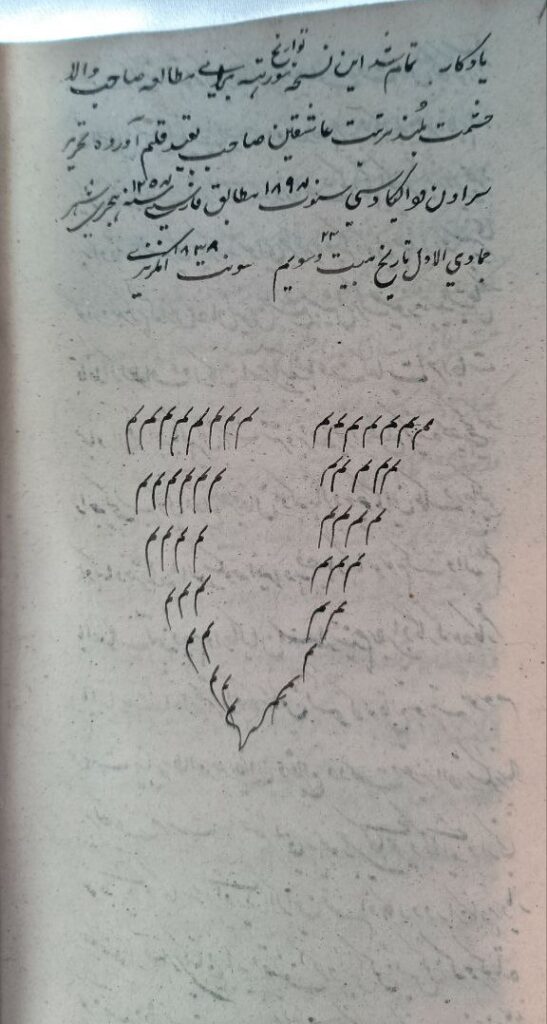
- MS Or. 464 (the Tawārīkh-i Sūrathe (تواریخ سورتهه)) is a local history deliberately aiming to add oral narrations of Jagunath in Surat County of Gujarat which have not been mentioned elsewhere. The work was originally written for James Erskine (Perhaps John James Erskine (1771-1833), a member of the governing council in Penang 1810-26) and this copy was made in 1838. The author adds all the names in Sanskrit alongside the Persian text, too.
- MS Or. 468 is the original copy of a travelogue of Claudius James Rich (1787-1821), relaying his 1235/1820 journey to different cities in Kurdistan, both in Ottoman and Persian territories, and Mesopotamia. Rich died in Iran (presumably Shiraz) in 1821, and this copy was dedicated to Mountstuart Elphinstone, who was a friend of James Rich, in 1237/1822.

- MS Or. 471 is the autobiography of Shāh Shujāʿ al-Mulk, the last Durrānī ruler (r.1803-09) written in 1241/1825-6 in exile for Elphinstone. The copy must be the autograph or a first-hand copy.
- MS Or. 472 is also dedicated to Elphinstone as a gift upon his trip to Ahmadabad on 22 December 1855. This also seems to be the autograph, briefly mentioning remarkable dates and buildings (and their establishment dates) in the city and was decorated with leaves of very fine shikasta nastaʿlīq calligraphies stamped on the folia, although the calligrapher had asserted that these were training pieces, trying to emulate Darvīsh ʿAbd al-Majīd Ṭāliqānī’s works, and had complained more than once about the ink and the paper.

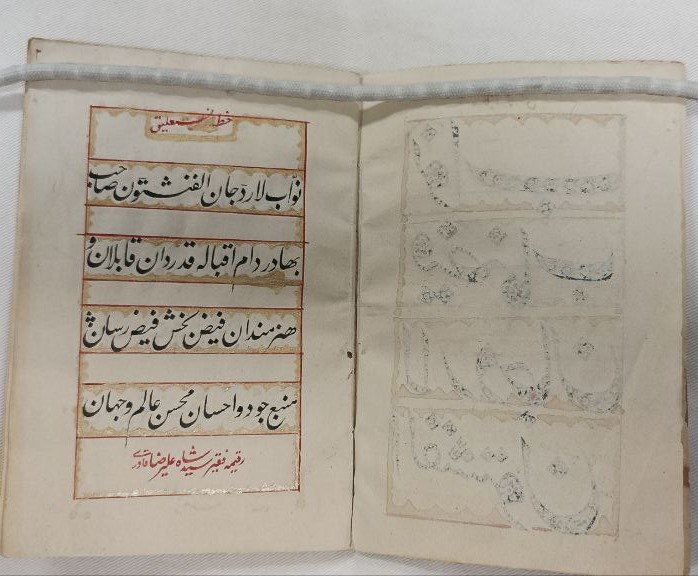
- John Elphinstone’s interest in calligraphy is affirmed by the undated MS Or. 473 created for him. It contains specimens of different Persian and Arabic calligraphies with their names, 15 each. Although, as expected, the calligrapher had different levels of expertise in them.
Four other manuscripts belong to the same category of local history and there is evidence suggesting they should also be considered related to Elphinstone.
- MS Or. 465, the Jawāhir-i ʿAbbāsiyya was produced in 1838 in the same workshop and by the same scribes as Or. 464. The work is a history of the Abbasi household who ruled over Bahawalnagar and claimed to be descendants of the Abbasid Caliph Rashīd. The work had originally been dedicated to the last ruler of the family to date, Muḥammad Bahāwal Khān (r.1825-52) shortly after his reign began, so this copy was transcribed almost a decade after the original.
- MS Or. 467, the Gulistān-i Raḥmat is a history of Afghan warlords, especially Ḥāfiẓ al-Mulk Ḥāfiẓ Raḥmat Khān (d.1774). Apart from the subject, the manuscript looks similar to both Or. 464 and 465 and must have been produced in the same workshop.
- MS Or. 470 is fraction of a scattered copy of the Tārīkh-i Aḥmadshāhī commissioned by Aḥmad Shāh Durrānī (r.1740-72). It was already dispersed in India, as a Persian note mentions the codex as ‘233 written folia, of poetry and prose’, evidently not being able to identify the work (‘poetry’ mentioned by it is indeed a part of the work which contains hundreds of mutaqārib couplets relaying the events – which are told more realistically in the prose text – in an epic fashion, apparently referring to the Shāhnāma).
- MS Or 466 is a Divan of Hafiz, written on British papers which have the dates 1794 and 1799 in their watermarks. A note on the inner side of the cover states the manuscript was given to the writer by Sir. H. Strachey in 1856 and gives an account about the latter’s life and years of service in India. This is probably Elphinstone’s own handwriting.
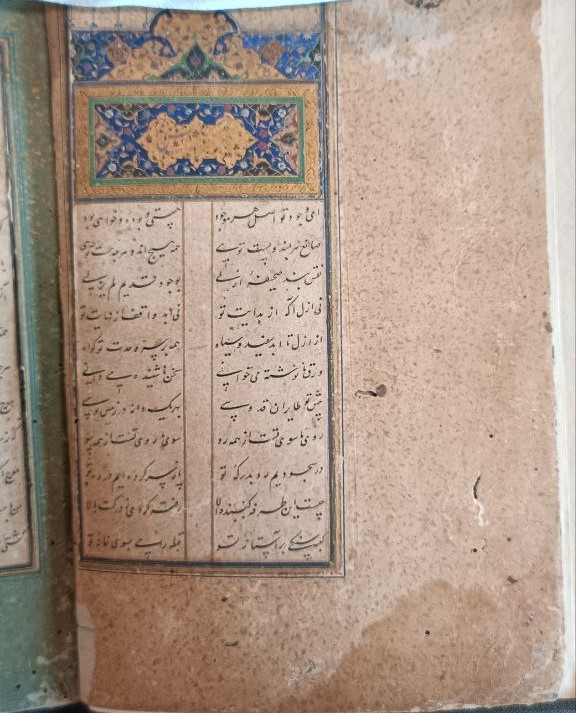
The oldest, and the only elaborate manuscript of the collections is MS Or. 469, a 965/1657-8 copy of the Shāh u Darvīsh (also known as Shāh u Gadā/Gidā), the allegorical ‘love’ story by Hilālī Jughatāʾī Astarābādī (d.936/1529). It has one illustration and is embellished with polychrome illuminations and decorations.
MS Or. 474 is a printed Indian book of mathematics practices with illustrations and Sanskrit text, to which English explanations and answers were added in a fine calligraphy by a civil servant alive in 1820. He has written his own name in two forms, slightly different from each other and from the form he is often known as: Trivengadachari Shastri.